Have you ever wondered what it is like to become a Theology Master? As I work toward my MA in Theology, I will share insights, stories, ideas, and strange happenings.

Friday, October 4, 2013

Why the "pure gospel" doesn't exist, or at least why you'll never know it.


What is the Gospel?

Go ahead, think about it for a moment.  What is the Gospel?

How does the Gospel interact with groups of people?  Does it take on cultural images?  Is it rearticulated with new cultural language?  What about the form of worship?  Does that change with new cultures?  How about the form of leadership in the Church?

Let me draw you a picture.


In this picture, the Gospel is seen as being beyond history, and beyond culture.  When the Gospel reaches a group of people, it is simply translated to fit into that people group’s culture.  A good example is Jesus.  He came to proclaim the gospel of the Kingdom of God.  He taught using agricultural parables, and economic, religious, and political metaphors that made sense to 1st century Jews.  According to this model, the Gospel was simply translated.

What happens when Culture A, wants to share the Gospel with Culture B?  If this model is correct, Culture A must first become so self-aware that they can decipher how their living of the Gospel is being formed by their culture.  The gospel was “inculturated” or made tangible in their culture, so they must sift through all of their own cultural residue, in order to arrive at the “pure gospel” that is not “tainted” by their culture.  It is this “pure gospel” that then needs to be shared with Culture B, by translating the Gospel into Culture B’s culture!

The history of mission is often full of imperialism, where “sharing the gospel” actually resulted in the imposition of one culture upon another.  When European missionaries arrived in countries in Africa, tribal drums were seen as evil, and European Hymns were the only acceptable songs for worship.  Today we think of this type of mission as a tragedy, resulting in the destruction of local culture. 

You know what I think?  It’s not the missionaries’ fault.  It’s the faulty diagram.

The gigantic assumption is that the Gospel is beyond human culture and that we can somehow arrive at the “pure gospel.”    That assumption is too idealistic.  Don’t believe me?  Ok, let’s try another experiment:

At the onset of this post you reflected on the question, “What is the Gospel?”  Open up a Word document, or grab a piece of paper, and jot down a couple notes about your answer.  The only caveat, do not use human culture to do so.

So what’d you come up with?  “The Father loved us so much that he sent his Son to reconcile humanity to himself through Christ’s death and resurrection and subsequent transformation by the Holy Spirit?”  Something like that?  Is that pretty close to the “pure gospel?”  Here are a few examples of cultural influences in that “pure gospel.”

1.       The use of language, which is a cultural construction.
2.       (not fair you say) Ok, the use of family analogies to explain the Divine Plan:  Father, Son, Holy Spirit.
3.       The use of historical data (Christ’s death and resurrection).
4.       The use of Jewish religious terminology translated multiple times: “Christ” is the English translation of the Greek translation of the Hebrew word for “Messiah” or “Anointed One.”  The only way to arrive at the significance of that word is to dive into a Hebrew understanding and expectation especially as it was understood to a 1st century, Second Temple, Partly-Exiled, Hellenized, Jewish community. Yikes!
5.       Should I go on?

My point is this, IF there is such a thing as a “pure gospel” that exists outside of culture, we don’t know what it is!  And even if we did know what it is, we have no way of talking about it or understanding it outside of our own culture, or shall I say, our own context.

Let me draw you another picture that may more accurately depict the situation:

This picture shows that the Christ event took place within a particular culture, namely the 1st Century Jewish culture.  That event was interpreted and retold by the original Christian community, and then continued on through time, up until our present day.  As the Christian witness moved on in time, cultures changed, and the Christian community expanded into new areas with new cultures.  The Christian witness was in an organic relationship to culture.  The Christ Event influenced the cultures, but the cultures also influenced the way the Christian community understood the Christ event.  Thus the line representing Christian witness does not only reflect the Christ Event, it reflects cultural characteristics as well.[i] 

A very simple example of this is in Christian worship.  Early Christian worship was inspired by the synagogue, and the breaking of bread (both historical and cultural).  As time moved on, there arose the need to formalize the way Christians worship, and the great Liturgical traditions of the East and West grew.  In the East, liturgy took on a more poetic, mystical flare inspired by Greek culture and language.  In the West, the liturgy reflected the Latin and Roman tendencies toward order and clarity.  Thus if you attend a Divine Liturgy, followed by a Roman Mass, you would note an overall similarity of significance, but very different form.  Worship is only one of MANY examples we could reference.

You, as a participant in the history of the Christian community, also have a culture through which you experience EVERYTHING.  The way you experience the history of the Christian community is also through your culture.  Here’s another picture:


You, as a person experiencing the Christian witness, and through that, the Christ Event, can only see and experience the witness through your own cultural lens.  It still affects you, but only through your language, symbols, value structures and so on.  There are a few implications for this:

1.       You will never see the “pure gospel” nor the “pure christ event.” 
2.       The Christian witness to the Christ event is informed by human culture.
3.       Human culture is informed by the Christ Event.
4.       This is a messy endeavor!  But this messiness wouldn’t be so surprisingly messy, if we never had our very first “clean” diagram.  What I’m suggesting here is nothing more than the human experience of life.   One of the mysteries of the incarnation is that God took on the stuff of human experience.  He took on flesh and with it, time, history, culture and so on.  The human, contextual, cultural experience is made sacred through the incarnation.  So when we see that the Church is influenced by culture, we need not shriek back in fear.  If God was influenced by human culture, why wouldn’t the Church?  

This is my introduction into the class “Theology of Ministry.”  We have read a book by Kennan Osborne in which he shows some of the ways that the Church’s views of ordained ministry and the laity has been informed by history and culture.   So if you were wondering what all this culture talk means, or how the Church has changed with culture, hopefully our next few posts will be of interest to you!


[i] For a picture trying to capture the complex interplay between culture and the Christ Event, this is too simple.  The cultures are influenced by each other, and the Christian witness maintains cultural characteristics from say the 1st C. Jewish Culture even as it moves into Culture x. 

Wednesday, September 25, 2013

Forming Your Conscience (Ft. Cap'n Crunch)


A dedicated reader of this blog hassled me because he has been living his life on the edge of the abyss of ethical chaos.  It’s been weeks and all I’ve left him with is:  Your conscience can be wrong.  Moral statements that help form your conscience can be wrong.  Good luck!

While I won’t pretend to resolve this problem here, lets at least dig a little into the problem, and see if there aren’t any good ways to form your conscience.

Experience is a great place to start in forming your conscience.  Remember I mentioned the teenager who smacked the icecream cone out of the little boy’s hand.  I learned a lot from watching that take place.  I would have learned even more had I been the one being a jerk.   Often it’s our own personal reflection on our experience that helps make sense of our future moral life.

Moral statements are another great place to look, even if they are wrong, or can be misused!  “Do not murder” is almost always a good former of conscience.  I would suggest being a little discerning about the statements you allow to form you.  Miley Cyrus may not be a moral sage by saying (without words) “Enacting violent sexual acts in front of millions of viewers is a good way to sell albums.”  Whereas Gandhi’s (alleged) “Be the change you want to see in the world,” will almost always help you out. I of course encourage you to look toward Scripture.  Please oh please, don’t try to form your own ethical framework from the bible, and call it “Biblical Ethics.”  By “Biblical Ethics” do you mean having multiple wives, or sacrificing your son, or calling a death sentence down upon someone for not tithing properly?  What I’m trying to say tongue-in-cheek, is that you absolutely need a community to help you form a moral system, even if that system is based on the bible.  No moral system is simply based on a book, nor on ideas about how to act. All moral systems are created and sustained by human society and culture.  CS Lewis is quick to point out that human moral systems tend to have a lot in common.  There is something universal within a person that generally points an individual and society to lots of goods.  In most cultures one lacks honor by forcing oneself on another.  But societal ethics also have a lot uncommon.  They vary in the treatment of woman, care for the poor, relationship to the earth, the fetus, etc.  Here’s what I’m getting at.  Whether you know it or not, you are being formed by a group of people.  So be intentional about what group you are being formed by.

In the Catholic Church, we interpret scripture a certain way and as a community of interpreters, we have a group of people who speak to represent what we believe and how we act.  We call that the Magisterium.  Sometimes people get all down on us Catholics about the Magisterium for two reasons.  1.  Talking about a group of people representing or teaching on behalf of the rest of us, sounds like a top heavy view of the Church.  A bunch of old guys in cassocks telling us how to live our lives.  No thanks.  2.  We have this inconvenient infallibility thing. While individual bishops cannot claim infallibility in any sense, the entire college of bishops are preserved from error when, “in their authoritative teaching concerning matters of faith and morals, they are in agreement that a particular teaching is to be held definitively and absolutely.”[1]  So to set the record straight, when Pope Francis proclaims, “Cap’n Crunch is the best cereal in the world!”  We are not bound to only eat Cap’n Crunch.

 As for number one, keep the image of the old men in cassocks.  What can you do, they love them cassocks.  Ditch the idea that the Magisterium acts above the Church proclaiming moral guidelines for us to simply open our mouths to digest like Cap’n Crunch.  The ideal way of viewing the church is that the Magisterium acts organically within the Church.  I am the Church, the Magisterium is the Church, we are all the Church.  Some would say that more important than teaching, the Magisterium must first listen to the faithful and the theologians.  Hopefully the teaching office of the Church accurately reflects what the Church believes.

As for number two a lot could be said, but I’ll keep this brief (yeah right).  The entire college of Bishops can theoretically speak infallibly about matters of Faith and Morals.  This has been done concerning faith many times.  Take the defining of Jesus as fully God and fully human at the first Nicene Council as an example.  When it comes to morals, some would say that the Magisterium has never spoken infallibly about moral guidelines.  Yes of course much has been written about the dignity of the human person, and workers right, and just immigration reform.  All of these moral guidelines have been helpful, but they have also been very localized.  Do not be dismayed by the lack of universal moral guidelines.  Here’s why.

We’ve already determined that moral statements are limited.  A moral statement can rarely be universalized, meaning: Human situation through history is so varied, so fluid, and so specific, that one moral statement about contraception, for example, could never capture the wide variety of situations.  What the Magisterium is capable of doing is twofold.  1.  Understand and Teach Gospel VALUES.  The underlying value of all of the writing about contraception is basically this: husbands and wives love each other completely the way Jesus loves the Church.  It’s a beautiful value that the Magisterium is very capable of articulating again and again throughout history.  2.  Apply Gospel Values to specific situations.  The Magisterium as a global, multi-cultural organization is capable of applying gospel values not universally, but specifically to different situations.[2]  I believe we will never have a universal, objective moral guideline that fits every situation, but the Magisterium (a listening Magisterium, mind you) has the moral wisdom accrued from a couple thousand years of contemplation on the human situation.  Lastly, and most importantly, the Magisterium as an important part of the Church is guided by the Holy Spirit in its teaching office.  Guidance by the Holy Spirit may not always result in infallible teaching.  Still, the Holy Spirit living and active in the life of the Church is able, more than simple human reflection, to apply Gospel values to specific human situations in a way that is life bringing.

There you have it.  Form your conscience by careful reflection on your own experience, moral statements, and sacred texts.  All of this reflection must never be done in isolation.  Instead you need a community of people that are hopefully inspired by good values (dare I say, virtues?) to help apply those values to specific situations.  I suggest turning to the Magisterium for living and contextualized moral guidance.


[1] Dogmatic Constitution on the Church. “Lumen Gentium.” Vatican II, November, 21, 1964. 25.
[2] The Church is only capable of a global perspective in so far as the Magisterium listens to the faithful and theologians, AND listens to global perspectives.  There is a tendency to think of the Magisterium as Euorpean/American.  For a long time Euro/American perspectives have dominated.  To be truly Catholic, the Church needs to lose its hold on Western thought and experience.

Thursday, September 12, 2013

Fall 2013


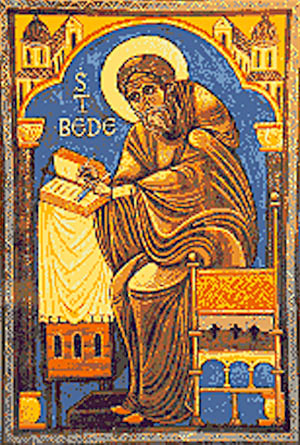
"I have always delighted either to teach, or to learn, or to write." -Venerable Bede

Every Sunday as I make my way back to my pew after communion, I see that quote painted on the back wall of the church building. Perhaps it doesn't seem like the most applicable quote to ponder after receiving the Eucharist, but I am struck by it every time!  Something about being in communion with the most primordial reality, Christ's very Self, puts me in touch with some of my most basic personal yearnings.

Classes have commenced, beginning my second year in the MA Theology program.  We have new faces in the program, familiar faces, and the absence of our classmates who have completed their program.  People ask me how I'm doing, and I say with a grin, "I'm back in school."  All is right in the world.

This year will be a little different.  This first semester I'm studying "Theology of Ministry," and "Theological Foundations."  Two very promising courses.  Next semester I have no scheduled classes so I will be working on my Masters Thesis.  Now's not the time to reveal what I'm working on, but I promise you, it will be exciting.

As for this Blog, I hope that we can finish up our brief look at Theological Ethics, and then I'll try to keep up with current posts on current classes. 


Friday, July 26, 2013

Stuck Statements and the Sticky Situation of Conscience Formation


We left our last post acknowledging that even if I had a talking cricket in my pocket, listening to conscience is difficult.  And now I will add that forming it is no simpler.  The aspect of conscience that O’Connell called conscience/2 is able to be formed.  What this means is that in the case of the pro-life/pro-choice drama, two people’s conscience can be formed in radically different ways.  What this also means, and I’m looking at you, reader, is that your conscience can be malformed, and wrong! *JUDGMENT*

Ok no judgment here, because my conscience tells me it’s impolite to judge other people.  But we don’t have to look too hard to find a person or a group of people whom I bet you would agree have been malformed.  Take Westboro Batpist Church as an example.  Some folks may agree with their underlying doctrine.  But I think that most people who read this blog would agree that protesting at someone’s funeral while holding up signs that say “God Hates Fags,” is an egregious form of disrespect and, to put it mildly, blasphemy.  Talk to a member of the church, and they’ll tell you they are only doing what God desires.  Persons and group of people can have consciences that are radically malformed.

One of the key questions for theological ethics is “how do we form our consciences well?”  Where can this floundering moral being find guidance among what seems to be conflicting pools of moral wisdom?   The most basic place to find guidance is in our own experience.   Once, while walking through a park, I saw a little boy enjoying his vanilla ice cream cone.  Then some rambunctious teenager walked by and knocked it onto the ground.  Seeing the little’s boy’s face, and the ache in my gut as I empathized with him, teaches me more about morality than hearing the statement, “Its rude to ruin someone’s afternoon treat.”  That’s not to say that the statements aren’t good, and that they don’t help us out.  “Thou shall not kill.”  Dead on, right?  (get it)  Statements are good, and point us to the good, but they are limited.  For example, in the midst of a moral crisis, how often do you scroll through lists of statements to inform your choices?  Additionally, statements are stuck.  Oh yeah, I’ll say it again, STATEMENTS ARE STUCK.

Statements are stuck in a lot of things and as a rule of thumb, if its stuck in something it can only be so useful.  Speaking of the rule of thumb, that illustrates this idea perfectly.   One of the origins of that phrase comes from a moral regulation that helped to curb spousal abuse.  In the 1700s a judge ruled that a man could legally beat his wife so long as the object used was less than the size of his thumb.  So the “rule of thumb” is stuck in a historical situation.  The situation includes the time period (1700s), world location (the west) the cultural norm for the family (its ok to beat your wife), a judicial process, on and on and on we could go to develop the historical situation.  Well the rule of the thumb is not really helpful anymore.   The statement is stuck.

Another statement that is stuck, but is notorious  for people trying to get it unstuck is Leviticus 19:28, “You shall not make any gashes in your flesh for the dead or tattoo any marks upon you: I am the Lord.”  Raise your hand if you think that Moses had in mind that the Israelites may walk into “Ink Assassins” on the corner of 26th and Peach St., and get “Mom” tattooed on their arm.  Probably not, as tattoo parlors were few and far between in the promised land.  They’d have to go find a group of people who use tattoos as part of the worship of their god, or find a prostitute whose profession was identifiable by her tattoos.  Getting a tattoo to honor a foreign god is a little different than memorializing your mother.  The point here is that the statement is stuck!  Don’t try to unstick it or else you will misrepresent the statement.  Ok you have issues with me suggesting that a biblical statement could be right in one situation and then wrong in another.  Let’s look at another one (tough crowd around here).

Leviticus 12:2,3: “Tell the Israelites: When a woman has a child, giving birth to a boy, she shall be unclean for seven days, with the same uncleanness as during her menstrual period.  On the eighth day, the flesh of the boy’s foreskin shall be circumcised.”  That’s a pretty straight forward statement.  When you have a baby boy, circumcise him on the eighth day.  If you are a St. Paul reading Christian you would know that Paul is not keen on circumcision.  Check out Galatians five.  So the bible makes a statement that men should be circumcised and then later the bible says we should not be circumcised.  Either 2000 years of Christians have missed this obvious contradiction OR my basic suggestion was right, statements are stuck, and a moral statement could change and be wrong, even if it’s from the bible!

In class we discussed a situation brought up by O’Connell.  Imagine being in Nazi Germany, and harboring a Jewish family in your basement.  Soldiers knock on your door and ask, “Are there any Jews inside?”  What do you do?  We could start scrambling through a list of statements to see if we could lie.  We would quickly learn that we shouldn’t lie.  So either give up the family (and probably get you and your own family killed) or lie.  I’d go for the lie myself.  O’Connell has more to say about this, but for now let’s simply acknowledge that the statement “Do no lie” is limited because it tends to get stuck in ideal situations.   I believe that in the Nazi situation, “You should lie” more aptly applies.

Sheesh, after all that it appears we are still floundering with consciences that could be wrong, and moral statements that could change!  We are not any closer to finding a moral guide that could help form conscience/2 (other than experience).

So what do you think about all this?  How do we navigate limited moral statements that contain wisdom in one age, but lack wisdom in another?  Where do we turn and how do we form our consciences?

Thursday, July 4, 2013

The Cricket Inside All of Us


In the Disney classic, Pinocchio, Jiminy Cricket is given the job of directing the young puppet in the right paths.  Here is his first lesson:

"Now you see the world is full of temptations."

"Temptations?"

"Yep Temptations. They’re the wrong things that seem right at the time. But uh, even though the right things may seem wrong sometimes, sometimes the wrong things may be right at the wrong time. Or uh, visa versa. Understand"

"No, But I’m going to do right."

" 'Adda boy Pinoch. And I’m gonna help you."

If Pinocchio was confused about right and wrong, who can blame him?  Even with the help of a fairy-given conscience/cricket, he was still confused about how to be a good boy.  Looking inside ourselves we see that determining the right and actually doing it are sometimes very difficult.   Jiminy Cricket has no small task of helping the puppet to becoming fully human from the practice of good decisions.

Catholic moral theology has good news for all of us.  Every human is aided in the pursuit of good by a God-given conscience.  However you conceptualize your conscience, from a cricket, to a little angel on your shoulder, you are hopefully familiar with that small voice or inclination or feeling inside you that helps you to determine right from wrong.  So listen to your conscience and the moral life is a walk in the park. End Post.

Just kidding.  If only it were that simple!  For one thing the motivation of my conscience is sometimes suspect.  It’s a gift from God, but that doesn’t mean it always gives me the best advice.  For example the other day I thought I’d be helpful at work by replacing a light bulb.  My conscience which urged me toward helping others failed to consider the labor union and job descriptions and restrictions not to mention the dangers of hanging over a ramp to replace the bulb.  My conscience had nothing to say when I was scolded for “not doing my own job.”  So it’s from God, but not always correct.  It’s also deeply rooted in me, a human.  As the example above illustrates it sometimes makes mistakes, and can be motivated by some selfish desires.  Conscience is neither fully Divine nor fully human.  It is somewhere in the middle.

Unlike Pinocchio, humans usually obey conscience, even a selfish, mistaken conscience.  Think for a moment about the last time you did something that in retrospect you know was a bad decision.   Few of us know with certainty what is bad and decide to do it anyway.  Most of the time our conscience is simply confused.  Timothy O’Connell, whose book we read for my ethics class brought up the example of Nazi Germany.  “Were they sinners, refusing to do what they knew to be right? By no means. What must be said (and it is a universal, often tragic human weakness) is that, by and large, the people of Germany were guilty of a moral blind spot, of an inability to see and appreciate the evil of their situation.”[1]   We humans want to do what is good, but often what is good gets muddied and confused.    Thus O’Connell describes three dimensions of conscience which helps illuminate the complexity.

Conscience/1, he says, is that basic human desire to do good and avoid evil.  This is why we almost always obey our conscience, because we really want to do what is good.  This desire for the good is universal, but what is defined as good is of course not universal.  Take for example the hot button issue of abortion.  Pro-Life and Pro-Choice people both think that we should do what is good.  But they both hold up two different banners about what is right.  “All humans at all stages of development have the right to life.”  “All women have the right to make decisions about their own bodies and reproductive health.”  With the many disagreements between the two camps they would both agree, “Humans have the responsibility to do what is right!”  Which is why we need conscience/2.

Conscience/2 is the process that we all undergo in determining what is right.  It is the process of consulting moral guidelines, societal stigmas, family values, personal experience, our favorite song lyrics, and any number of sources of “moral wisdom.”  You will notice that there is nothing universal about this process and people will disagree.  What this means is that conscience/2 can be formed differently for different people.  But what is certain is that every person will form her conscience.  The question is, “How well will it be formed?” and “How do we form it well?”

Lastly there is conscience/3.  Conscience/3 is an event or a particular judgment of conscience upon an act.  We would do well to listen to that judgment and do it.  For the reality is that in all cases, the human person must do what he believes is right.  What does it say about a person who believes that an act is evil, but does it anyhow, or the person who believes an act is good, but avoids doing it?  We must do only what we believe is right.  Hopefully you’ve engaged in a process of conscience formation so that what you believe is right is actually right!  Just like Pinocchio, the better your conscience is formed, and you learn to listen to it, the more fully human you will become.


[1] O’Connell, Timothy. Principles for a Catholic Morality. New York: HarpersSanFrancisco, 1990. P 111.